Featured in this Video are Grammy winner Jim Peterik and Keyboard ace Chris Neville having an easygoing impromptu jam featuring the HAMMOND 44
The newest HAMMOND has no drawbars, and no tonewheels, but it has all the soul of our legendary organs. Say hello to the HAMMOND 44 MELODION. It’s a KEYBOARD HARMONICA- the FIRST WITH 44 KEYS and a BUILT-IN DYNAMIC MICROPHONE. From the first time you pick it up, you’re hooked-The ease of EXPRESSION and EMOTION will startle you. If you’ve ever been envious of sax players, guitarists or harp players who stand at the front of the stage and really get into it, now YOU HAVE THAT CHANCE. Even if you’re not a keyboard player, the Hammond 44 is easy to play-and what a sound! PLUG INTO ANY AMP, use EFFECTS PEDALS, to make a sound that is DISTINCTLY YOUR OWN.
Welcome to Melodicas.com Melodica is the name given to a wind instrument created by the German company Hohner in the late 1950’s. Variations of this keyboard have since been manufactured by numerous companies in different regions of the world, each giving the instrument a different name i.e. pocket piano, blow accordion, melodeon, diamonica, melodyhorn, wind piano, keyboard harmonica, pianica, cassotto, MyLodica etc- enough to give this little instrument a massive identity crisis requiring an orchestra of therapists. This site was designed to educate, sell & promote melodica keyboard instruments.
After This Shot, I wrapped my camera in my sweatshirt an strapped it on top of my board, which was on my Wheele behind my bike. I was 3/4 of the way up the trail, when this girl cycler caught up with me and said I might want this. She was holding my camera and my sweatshirt. I thanked her and she rode back down the trail. I wished I took her photo. Thanks so Much!
Editor’s Note: In conjunction with our annual Surfboards Issue (On newsstands Nov. 18), we will be posting one interview per day with a craftsman who contributed to the issue. Some are the biggest names in the bay; others are underground and want to keep it that way. But all of them share an equal passion for the crafts that move us forward. In these tough economic times, they all have a lot to say on where their craft is going. First up: 2005 Shaper of the Year, William “Stretch” Riedel. Name: William “Stretch” Riedel Zone: Santa Cruz Years Shaping: 30 Boards Per Week: 25-35 Specialty: Don’t have one, I do it all
Is your business better or worse since the Clark Foam shutdown? Clark’s closure had zero effect on me. Do you feel polyurethane foam/polyester resin will always be the dominant surfboard construction? I think that that question is better stated, do I believe that polyester is superior? And I don’t believe that there is a superior material. Everything has its place. I think that epoxy is a superior resin for a number of reasons. But blank-wise, the blank is an ingredient in the recipe, whereas I don’t use that ingredient that much, it’s a good ingredient in some recipes it’s better. Do you think there's an increasing or decreasing appreciation for a custom surfboard? Right now I think it’s decreasing. It’s decreasing and I think that that is because of, number one the media. And number two the clothing companies don’t necessarily want to have big shaper names; they’re dangerous to them. So they will tend to back things like Super Surfboards. A lot of the big companies, you know Billabong, Quiksilver, have surfboard labels in Australia, in Europe. That’s to their advantage. It’s market driven, the decline right now. I don’t believe that it’s possible to sustain it, as long as there is somebody out there who’s willing to do the job and do the job to it’s full extent; learn hydrodynamics, learn composite technology, learn the tools, craftsmanship. I think that they will always be able to make a superior board, and guys that can really surf will always want the best thing that they can get their hands on. The non-shaper driven label, if you were a shaper and your name isn’t on the board, what do you care what it looks like? What do you care what it rides like? It’s just a job. If your name’s on it, it changes things. If it’s your label, it changes things. Are quads declining or increasing in popularity? Steady. What's keeping you afloat? Custom clientele? Shop accounts? Surftech? That changes for the time of the year. We’re going into winter-time, so this is our custom time of the year. The shops are tentative to stock boards this time of the year, but the guys that really surf now is when they order boards. If it hasn't already, will your surfboard production ever have to go overseas? There is a place for overseas production. Will we? I don’t know. We tried it, didn’t like it very much, didn’t feel real good about it. But I think that there’s a place for it. The labels that are going overseas, you can get a cheap board. For the beginning to intermediate surfer who may need high performance, but doesn’t realize it, it gets him going, it gets him surfing, it gets him into a short board, it gets him into the industry, or into the market. What kind of music do you like to listen to when you shape? On the computer you can go this website, Pandora, and you type in a band name or 80’s music, or punk rock. I type in NOFX and a bunch of NOFX comes up and Me First and the Gimme Gimmes, and Green Day, and that kind of kiddie punk. NOFX is my favorite though. How much time do you spend on a single board now? Depends. What’s that board? I don’t have a specialty, so shortboards, like a stock shortboard I’ll spend a half hour, 45 minutes, on each one, and I’m not the only one who’s shaping it. We shape differently than anyone else in the industry. I go through every single board three times and I’ll spend ten or fifteen minutes at each step and then somebody else will do some of the work for me. Some guns I’ll spend 2 or 3 hours on sometimes. A couple of hours on a tow board, depends on what it is, some of the jobs are a lot. Do you spend more time on the computer screen or in the shaping bay? All my time is in the shaping bay. I don’t spend any work time on the computer, you know I’ll go on Surfline and check it, or look at the design forum. But I don’t design on a computer screen. I don’t think it’s bad; it’s just not me. The Mona Lisa can’t be built on a computer. I’m not trying to build a floatation device. How important is teamrider feedback to you? Everything, I don’t surf, I haven’t been able to surf for 20 years. I have to get feedback, it’s the only way. When I broke my neck I could surf pretty well, but by the time that you really know how to shape, your 20 years into it, I’m still learning at 30 years into it. I don’t know any 50-year-olds that can go out and bust an air. You’re gonna be 50, 45 by the time your really good, but you can’t go out and test what your making. You gotta have rider feedback. What kind of board do you enjoy shaping most right now? It changes day to day. The most challenging boards are the ones that I like to shape the best. That would be some of the Pipe guns, Maverick’s guns, Tow boards are really hard. Are you actively pursuing "greener" avenues in your surfboard production? We always have. We were one of the first, if not the first, to go to EPS Epoxy. Our foam is all recycled, all of our waste is recycled. To the point where we don’t use any virgin cardboard, all of our cardboard is recycled. We go over to SurfTech and grab all their cardboard boxes, we have all our foam shipped here in cardboard boxes and we reuse that cardboard to ship a board back out again. We’re always looking for ways to recycle.
FEATURED CLIP From: surfline SHIPSTERN GOING OFF Ryan Hipwood, Koby Abberton, Josh Kerr, Dean Bowen, and more get shacked out of their mind at Shipstern Bluff.
Opening the Door on the Quiet Revolution article from The Surfer's Path Words and photos by: Simon Buck Brought to our attention by: EGP
One of the pioneering brothers talks about all things Bonzer, one of the most influential board designs in surfing history. “There’s a line in a Talking Heads song that goes, ‘Never for money, always for love.’ That says it all really.” In a single sentence Malcolm Campbell has just encapsulated the whole ethos he and his brother Duncan have been working by for the past 37 years. The song he’s just referred to is “This Must Be The Place (Naïve Melody)”, and for over an hour ‘the place’ has been the bar at a Newquay surf lodge where the softly spoken, unassuming Californian has been holding every ounce of my attention.
From stories about the nascent days of Bonzer production in early 1970s California to explaining the technical elements behind the complex design’s performance, I’m starting to suffer from information overload. The tape is running out and at any minute my Costcutter biro will dry up. Trying to process the sheer volume of information has been an intense process, but there’s a reason why this exercise has been anything but a chore. Malcolm’s passion and enthusiasm for his craft and his drive to actively evolve surfing through his work is contagious to the point of being toxic. He doesn’t do this by shouting loudly about what he and Duncan have done – and, indeed, continue to do – for the surf industry. That wouldn’t be his style, obvious to anyone who has ever met him. Instead, he prefers to work away quietly on developing and improving on the established Campbell Brothers designs, most notably the Bonzer 5.
The sons of Jack and Gloria Campbell, Malcolm and Duncan grew up with their sister Ann in Oxnard, California during one of those golden eras of surfing. Jack was a huge influence in the young brothers’ early shaping days. A photographer by profession, dad was also interested in engineering and design, especially relating to marine and aircraft. With his knowledge of hull and wing construction, he suggested the boys apply some of the principles of hydro- and aerodynamics to their surfboard shapes. This led to the development of two of the most significant innovations in board design, which most surfers today take for granted: the three-fin setup and single-to-double concaves.
Today, there’s no doubt that Bonzers have a number of high-profile devotees. Many are professionals who ride them recreationally, outside of their ‘day job’, during times when eagle-eyed sponsors will be less sensitive. Taylor Knox, Rob Machado and Dan Malloy are three well-known names who openly endorse the merits of Malcolm’s creations. Taylor is a great ambassador for the Campbell Brothers’ creations and has been riding Bonzers recreationally for years.
“Because of the way they handle, there’s less to think about in setting up for each turn or worrying about them breaking out or losing power. That means I can concentrate more on what I want to do and put all my focus and energy into the moves. For me that really suits my style of surfing. They’re fast boards, and I love the drive and power they produce without losing any of the freedom of a thruster.” Rob Machado is another who believes the addition of Bonzers to his quiver is only a good thing. “I was stuck riding thrusters on the tour, but when I left it opened up avenues of surfing I’d always wanted to explore. I had a Bonzer built but didn’t ride it for maybe a year or two. Then I decided to take it on a trip to Chile. I rode it on the long left points, the perfect environment to test it, and I really got to appreciate it. I feel Bonzers are the perfect combination of the benefits of the speed of a single-fin with the edge holding and turning of a thruster.” Both these surfers have obvious admiration and respect for Malcolm and Duncan; the words ‘generous’, ‘giving’, ‘humble’ and ‘great guys’ are often repeated. Dan Malloy sums it up simply: “We’ve never been paid a dime to ride Malcolm’s boards, yet we still ride them all pretty often. The only reason that I can imagine this would be is that they are great surfboards.”
Simon: You started shaping surfboards when you were in your early teens living at home. How did your family background influence your approach to what you were trying to achieve? Malcolm: My mom was an artist and a painter, and my dad was a photojournalist. Basically, we came out of a creative family environment. Growing up in that environment helped us become individuals. That’s where it comes from, individual thinkers – artistically, creatively, politically. When we made that first three-fin Bonzer in 1970, that first bottom-turn was so dramatically different than anything else we’d ridden or made that we immediately realised this was something worth pursuing. That turn changed our lives because [up till then] we were kids making surfboards and having fun with it.
And that inspired you to think about it more seriously? Yeah. The further we pursued it, the more we realised this was an opportunity to contribute to surfing, which meant so much to us at the time. We were just kids learning to surf, learning to shape and build boards.
So although shaping eventually became a way to pay the bills, it’s as much, if not more, about making a difference? It’s all about reciprocal maintenance. Surfing provides so much joy – it’s our means of expression in terms of art and philosophy – but it’s really about giving something back to surfing. As far as our lives go, there has been no separation between working and our philosophy of life. All my best friends come from our involvement in surfing – my wife, hence our kids, everything.
By regarding what you do as your art, and by the very fact that most art conveys a message, is there a specific message you’re trying to put across in your work? Yes. It’s that all of us, as people, are not who we are but what we actually do. Since we have some degree of notoriety, surfing has become our vehicle to communicate with a wider community. Whether it’s directly through making the best possible surfboards or using it as a platform to speak about things that we really care about.
Is it difficult to combine work with the responsibility of consistently delivering the message? Shaping surfboards is my job, and it’s my obligation to shape the best surfboards that I can. It’s also my responsibility to educate myself in as many areas as possible in order to be able to contribute toward a more peaceful and just society. That’s the fundamental aspect of what Duncan and I are about. In that regard, I sign ‘Peace’ on every board and have being doing so since around 1972. Not in a trivial ‘Peace, man!’ way.
Is there a danger that the message could be misconstrued, projecting an image of the Campbell’s as ancient hippy shapers living in the past? That could be perceived, but I would say to them that every surfboard we make is, in a sense, a prayer or a salutation for peace. Every time someone looks at that there’s the possibility that within their mind they will spend that instant thinking, “What are they talking about?” or “What do they mean?” It’s a small thing, but over time it can magnify.
It’s obviously something you’ve spent a lot of time thinking about? Well, we can say that we want to make the world a better place, but how are we going to do it? There’s not a whole lot in a physical, big sense that one person can do, but if a lot of people can be focused on things in their immediate sphere, this can produce a better ‘consciousness environment’. We are activists at heart, and we sincerely want to make the world a better place. At the very minimum we try to make our lives an expression of our philosophies and ideals. Within the work sphere, Duncan does this with Cafe Haleiwa and with the Bonzer Front surf shop along with his daughter Megan. I do it through shaping surfboards, and now that my kids are grown up I hope to expand my activities a bit. All you can do is the best you can do. That’s a small thing we put forward; it’s the idea of no separation. There is no separation between our surfboards and our philosophy, the way we live our lives, and the way we try to interact with society.
“Campbell Brothers Surfboards” … as brothers what do you bring individually to the company? Duncan is more of the promoter than I am, which is good, we need that balance. Basically, I stay as invisible as possible – stay back and shape the boards. Duncan helps to keep the Bonzer in the public eye and available to the pros, but the bottom line is that the Bonzer speaks for itself. We wouldn’t be a thorn in the side if the boards didn’t work.
Is that how you see yourselves, a thorn in the side of the big players in the surf industry? I’d like to think that we are agitators for change. The fact is, since 1973, when the Bonzer was exposed worldwide by Bing Surfboards (the venerable California surfboard label), only a couple of companies have put a Bonzer in their lines. It does beg the question as to why this has been the case. Production difficulty has been one of the excuses, but the industry dealt with the Alan Byrne Deep Six channel design, so hell, I don’t really know what the problem is. There are a few guys, such as Bill Hamilton, Gary Hanel, Rich Pavel, Fletcher Chouinard of Patagonia’s Point Blanks, Doc Laush of Surf Prescriptions, and a few others sprinkled around who have built them.
Is it a global mindset against them? Not consciously. Over the years I personally have shown many top shapers how to shape Bonzers, but only a couple continue to pursue it. In 1990 there was an article in Surfer magazine in which we talked about how surfboard design could really move ahead if people openly discussed and shared their ideas and designs. That’s what we were doing – sharing the ideas we were working with to push design ahead. In fact we did a lot of work with Pat Rawson in ’88 to ’90, and that’s where the single-to-double concave thrusters came from. While working with Pat we showed him our five-fin as well as what we were doing with our single-to-double concave Bonzer bottom on our thrusters. When the thrusters first came out, we took a hands-off policy to wait and see how they panned out. We’d been making three-fins for 10 years prior to that, and then some friends said they wanted to try thrusters. We said, “Okay here’s the deal: We’ll make them, but you’ve got to let us put our bottom on them because it’ll give them more drive and more speed.” This was 1981, and we’ve never made a thruster without a single-to-double concave since. After this, we met with Rawson and shared our ideas with him. He had all these high-profile guys riding his boards – Tom Carroll, Gary Elkerton, Robbie Page, Bobby Owens, and others – and trying those thrusters with our bottom, and the boards worked great for them. With Pat’s influence and our behind-the-scenes work with him, the design spread … because those surfers were from all over the world. The modified single-to-double concave bottom has become the predominant bottom design.
What was he putting on the bottom before that? Most people had a slight vee, and Pat was working with Maurice Cole and his reverse vee. These boards had vee forward of the fins and flat in the tail. Simon Anderson was a rider first and foremost, and he had success on a three-fin of his own design 10 years after the Bonzer’s conception. Simon wanted to stabilize his twin-fin with a center fin. The thruster comes from the twin-fin, the Bonzer from the single-fin. They come from a different place in terms of design necessity or inspiration. Lots of guys in Australia were making and riding really short boards – 5’6”s and 5’8”s. We were doing that as well. The first Bonzer was 5’4”, and we added keel-shaped side fins to give the short single fin more speed and control. A lot of our influence in terms of style and approach was from Australians like Nat Young, Wayne Lynch, Terry Fitzgerald, Ted Spencer, David Treloar, that whole crew. The name ‘Bonzer’ was actually a serendipitous thing. My dad came across it in an Oxford English Dictionary, and that gave us the name.
You saw faults with existing designs? Since the boards were so short, they had trouble making the waves, so our desire was to make a short board that had the drive, speed, and holding power to ride larger waves. We had such wide tails on those boards, and that’s why you needed to increase the edge control, hence the long-base, low-profile, keel-style Bonzer fins. We lived in a place that was out of the glare of the media so we didn’t have any direct influences. In our area there were very few surfers; at high school there were only a few other people that surfed. The local scene was very small. We were able to grow up and surf and build boards without a whole lot of external influences, and that allowed us the space to be creative without any peer pressure. It was a great test tube. We had fantastic waves and happened to be friends with guys who turned out to be extremely good surfers.
Among your friends is there anyone of note who won any competitions? Some of us did a little in the local Western Surfing Association (WSA) amateur competitions, but nobody took it too seriously; everybody just surfed for fun. I know he’s my friend, but I maintain that Russ Short was as good as anyone in the world at that time. We have footage of him in Mexico in 1977, and I don’t think anybody else would’ve been surfing any better on those waves. That footage blows the minds of pros as well as everyday surfers. When you dissect what’s going on with that board and what he’s doing – the speed, the manoeuvrability, the timing – it’s amazing. We’ve got our own films from back then but it’s all on beachbreaks. You’ve got individual moves and tube riding, but there’s no time to really connect and get a long wave with a lot of turns. In the Mexican footage, Russ is doing everything – bottom turns, cutbacks, tube rides, nose riding – everything on that one wave. If you watch the board and compare it with footage of single-fins at that time, there’s a quantum difference.
Can you explain how the Bonzer system works? The primary purpose of the Bonzer system is to efficiently organise water flow. We have done this by designing fin and bottom systems that work in a synergetic fashion in order to maximize the use of the energy that is created by the water passing through the tail area of the board. To fully explain this can be a bit tedious, so I’ll try to be as clear and succinct as I can. When you’re doing a turn, the water travels diagonally across the bottom of your board. The Bonzer side fins have a base totaling 9-3/4” on each side, and a maximum depth of only 2-3/4”. The angle, combined with the shallow depth of the fins, allows the fins to come in and out of the water with little resistance. This makes rail-to-rail transition much easier, which in turn allows you to keep your board on the rail with much less effort. While turning, the fins on the inside rail are fairly vertical in the water, providing very refined edge control. As the water races across the bottom, the outside fins deflect it down and back through the tail. We have always looked at the water that escapes off the outside rail as unused energy. The combination of the Bonzer concaves and the long base of the side fins redirect far more water through the tail area than other designs. This maximizes the use of the force that is created during turns. The fins are essentially an extension of the concaves and, since water adheres to curved surfaces, there is very little disturbance as the water passes through the fin area. This dramatically reduces drag. Basically, we have tried to create surfboards that you can get more out of with less effort and energy input. It’s all about reducing entropy, which needs to become the emerging paradigm of the 21st century. Sorry about that last bit, but with us it is never just about surfboards. I can’t help myself.
So what are the fundamental differences between Bonzer and thruster performance? If you watch a Bonzer, you can see it gets up and down the face quicker, performs floaters with much more control; it’s maintaining the speed through cutbacks, being able to stay on the rail longer. Thrusters tend to want to settle back flat. If you watch any film of thrusters, there’s always a setup turn, especially on longer waves – guys will come back down after re-entry, and it’s rarely just one turn and back up the face. It’s back down, slight setup turn, then the big turn to go back up the face. That’s a style that’s developed but has been dictated by the limitations of the fin system. It’s a whole other can of worms discussing how style has evolved in relationship to the particular designs. Some of what are now considered moves are actually recoveries from where the boards are just maxed out. People go up off the top radically, then will turn to come off the top and get that bit of sideways motion before they come back down. That’s evolved into lip slides and so forth. You can do that on a Bonzer if you want to, but you don’t have to. You can get up and right back down the face quicker, and you’re basically ahead of the game. The other thing you notice on thrusters is that two thirds to three quarters of the way through a cutback, especially on a wave with less juice, the board wants to settle back down flat. You’ve got to do that secondary little turn in the cutback to get yourself around and back up on the white water. With a Bonzer you can maintain your speed through the cutback.
You can obviously apply physics theory to qualify how the Bonzer system works, but a lot of design modification must come from the riders themselves? Well yes, although it’s hard to quantify what’s going on with surfboards. Almost all innovations with surfboards are due to intuitive design combined with experiential results. There’s so much variation going on with surfboards, in terms of variety of waves, variety of surfers, changing densities of water, etc. It’s very difficult to get accurate tank testing. Basically the data that everybody gets is through experimentation, practical usage and application of the resulting experiences.
So the more people you can get to use them in more conditions the better idea you can have? The Bonzer still thrives simply because it works for all kinds of people in all conditions. Now with more top surfers giving our boards a go, it’s showing that they are more than able to stand up to tough scrutiny.
Do you think for Bonzers to do well on the open market they’d have to be seen to do well in the competitions? At large, yes. For general public acceptance, yes – competition would send it over the top. We maintain that it is possible for the boards to do well in contests, but it’s going to take somebody with the guts to really go out and do it. A lot of people feel that because your approach is slightly different on a Bonzer, you’re not going to get scored as well. It’s visibly different. It’s cleaner, and there’s not so much water flying around because the water flow out the back of a Bonzer is much more refined and controlled. It may not look as crazy in terms of initial impact, but when you watch what’s going on it’s just as radical but much more efficient. I really think a difference in perception is on the horizon and that bodes well for the Bonzer competitively. Obviously we’re hoping that we’ll gradually see more and more top surfers checking the boards out and riding them recreationally as well as competitively. In the last few years we’ve made boards for guys sponsored by other people, so they’re not going to be riding them in contests – Taylor Knox, Rob Machado, Dan Malloy, Mick Fanning, Brad Gerlach, Joel Tudor, Tyler Warren, Nathan Hedge, Mikala and Daniel Jones. We’re hoping that someone will step out and ride them more seriously in contests.
It does seem like it will take a minor miracle for the thrusters to be usurped in the immediate future though? In terms of performance, Duncan and I both agree that thrusters have been a great design. Obviously, they’ve got three fins. We’re not dismissive at all of the thrusters; you can’t argue with the level of surfing that goes on with those boards; it’s absolutely incredible how much surfing has evolved using them. But our basic premise is that it’s a three-fin triangulated system, which we pioneered, so we have no axe to grind. We just feel that there are inefficiencies inherent in that fin setup, and we feel that the Bonzer, all in all, is a much more efficient and versatile system. That’s the whole point of using the fin system and bottom design in tandem – working together in synergy.
The high technology and glossy R&D associated with some manufacturers doesn’t seem to sit well with your approach? I met with one of the partners in the design of Future Fins at a trade show in Japan. They’re doing all kinds of really neat stuff with various fins and tricked-out foils – some really complicated stuff. I think his name is Vince. He’s a very bright person, and I believe he has an engineering background; he’s doing some great work. But the fact is that if you take the fine, triangular keel shape of an original Bonzer side-fin, which is basically a slab of fibreglass, and stick it on your board in the proper position, you’ll make that board go faster and turn better. It’s pretty low-tech, but it has a high-tech result. It’s very simple, and you don’t need an engineering background to make your board go better. You don’t need high-tech facilities to mould all your fins. You can be a kid with a piece of glass, lay up 13 layers, cut out either a five-fin setup or an original Bonzer three-fin setup, and sand them by hand with a sanding block. Stick those on your surfboard and you can improve its performance – for pennies. Anyone can do it in their backyard. That’s where I stand on hi-tech. It’s about the whole system, not about an individualised foil. Definitely foils can make boards work better, but the dramatic difference that you’re going to get is not going to be as much as if you stick Bonzer fins on it. Again, the challenge is there to any shaper: Take your favourite board, stick the five-fin system on it, and see how it goes. You may not like it better at first; it all depends on how open people are to feeling the change and putting a bit of time into learning it. The people that get into Bonzers seem to be a bit more open-minded in general than what we’ve experienced over the years. We’ve made major changes, and we’ve been a major influence, but it’s been behind the scenes. You have so much preconditioning that it keeps you looking at other things. You’ve got to be open minded – not so open minded that your brains fall out, but you’ve got to be open to new experiences.
You feel that’s the secret of progressing surfboard design in the future? It’s the nature of things. Originally, in the ’70s, there were people making all kinds of crazy stuff; it was a really fun time. Especially the early ’70s, because people were making all kinds of wild stuff – flex tails, different tail shapes, different types of fins. Then surfing got bigger, and professional surfing began to change the nature of things. Advertising dollars changed what would go forward in terms of design, so it was a bit of a double-edged sword. You can’t just make stuff for the sake of making it. Back then, people were truly experimenting because there was a whole open new field; the boards were shorter, everything was wide open and as things did or didn’t work, they became a bit more refined. You’ve never followed the route into large-scale production as many of your contemporaries have. I’ve been shaping since 1968. From then until March 2007, I’ve always had a secondary job in order to continue to make Bonzers [Malcolm shaped for Al Merrick at Channel Islands from 1985 to January 2007], but they’ve never been my sole means of support until this year. So in terms of the passion that we have for the design, there’s very little connection with money, otherwise we would have quit doing it years ago. I could have made all kinds of other surfboards under ‘Campbell Bros’ and had a much bigger business, but we’ve chosen to stick with the Bonzer because we truly believe it has the potential to continue advancing performance and driving progression through design.
To make a unique statement the boards have to be unique themselves? Yes, the Bonzer experience is somewhat unique. We haven’t kept making them just because we’re stubborn and egotistical. To do what we’ve done and stay focused has taken passion. I ask people, “Why would I spend two thirds of my life making and riding surfboards that weren’t as good or better than anything else around?” You’d have to be masochist or an egomaniac. For the small amount of notoriety over 30 years (and even less money), ego doesn’t play much of a part. We’ve just been really focused on what we want to do, and it’s been a very personal thing for us.
My dad was the original inspiration for doing the three-fin. Along with him working together on the original design, there was our small group of close friends: Russ Short, Charlie Womack, Cliff Collinge (Duncan’s best friend and an incredible surfer and airbrush artist), and another friend, the photographer Craig Fineman, who shot all the photos of us. They were such an integral part of the Bonzer project. My dad passed away in 1976 when he was 58. Cliff died of cancer in 1993 at 38, way too young. My mom died that year as well. Charlie, who was an inspiration for the five-fin in 1983, died three years ago near Santa Barbara when a huge landslide covered his house. Shortly before that, Craig passed away after a long illness. It’s a shame that the people who were such a big part of the Bonzer experience aren’t around to share the bit of notoriety and the credibility that the boards are now getting. Again, this is such a personal thing in terms of our lives.
Do you feel that ‘Campbell Bros’ stands for more than just you and your brother – more like a brotherhood, a tight-knit community? It was a really close-knit group of people who were together for a long time. I think it’s somewhat a unique circumstance because it required a number of people that were willing to live on the outside of what everyone else was doing in surfing. They rode different boards and just fit in with the nature of the area. Oxnard was out in the hinterlands of Southern California surfing during the ’70s. Now, since around 1990, a second generation of close friends has provided the energy and support to keep the Bonzer experience vibrant.
Do you think that Bonzers will suffer because of the Quad? No. I pay little attention to what anybody else is doing. I have tremendous respect for the tried-and-true craftsmen in our business, but I have to admit that, as far as design goes, I pretty much keep my head down and stick to my own path. The point is, the Bonzer has survived every single design change and every fad. Thrusters aren’t a fad; they have developed into a mainstay. At the ripe old age of 37, Bonzers can still be taken out and ridden at the same or a higher level of performance than any design that exists. In terms of where other people go, I’m not concerned at all. We’re not in it to say we’re the be-all and end-all; we’re in it to provide the most versatile high-performance surfboard possible.
When I say ‘versatile’, it’s important because the Bonzer can be made to any shape and size to ride in any surf with the same fin system. From kneeboards to tow-boards to high-performance contemporary shortboards, longboards, and sailboards, the exact same fin-system can be used. You don’t even need to change the size of the side fins – just alter your centre fin. It works on anything in any condition, so it’s basically the Bonzer. In a way, I kind of feel in the center of the cyclone; it’s the calm in the centre because it’s been there from the beginning of shortboards, and it’s still there now. It’s the performance that dictates whether it will be around or not, and it’s not going away. The volume of boards that we sell is just a relationship to how many guys get on it and find it enjoyable. Where do you go from here? My fundamental concern is making custom boards and to continue to refine our designs. As long as everyday surfers enjoy the boards, we’ll be okay. It would be great for a couple of top surfers to put Bonzers to the test in the competitive environment. If this doesn’t happen, so be it. I do think that if someone went out and showed the judges something a little different in terms of more speed, better use of their rails, and more efficient transition between manoeuvres, the judges would take notice and reward them.
What would you like the Bonzer’s legacy to be? That it be seen as an archetype of the modern shortboard by pioneering the three-fin concept and the introduction and development of the single-to-double-concave bottom. In a human sense, though, I’d like the Bonzer to represent what can be done if you are passionate and stay focused on a dream. A few years ago Billy Hamilton said to me, “I can’t believe you guys stuck with it all this time, but I’m sure glad you did.” I can’t begin to tell you how much that meant to me. The Bonzer experience is and has been a ‘quiet revolution’, and that’s the way I like it.
Simon Buck is an award-winning freelance photographer based in the eastern badlands of Norfolk, England. A regular contributor to the surfing press, he lives with his fiancée, Rachel, and is the proud owner of two Campbell Bros Bonzers, which he claims to ride terribly. Visit: simonbuckphotography.com
In the last 5 years, I refined my love affair with the fat spud boards as a general category. Surfing trestles, mostly upper trestles for over the last twenty five years on a regular bases. I have come to feel the need for a board that will self generate speed from is own volition. Were talking about volume displacement over the rider's weight, it's about weight displacement. Cheyne Horan in 1984 was a perfect example of a guy who was looking for a board that would generate incredible speed with a minimal effort.
5 years ago I call Mike Eaton in San Deigo, to have him shape me a Bonzer surfboard, at the time Mike seemed closer than Malcolm Campbell, the originator of the bonzer surfboard with his bother Duncan Campbell. Malcolm lived in Ventura, Mike worked in San Deigo, 1 hour to San Deigo 2 hours to Ventura, Mike won. As a kid in 1972 I became aware of the Bonzer shape after seeing pictures of this kid name Russ Short ripping and of course he was riding the original Bonzer's shaped by Malcolm and Duncan.
This was my first Bonzer from Mike Eaton 5 years ago. I've had so much fun riding this board. It is now at Joe Hendig's Surfboard Repair Shop in Oceanside getting completely restored! Looking forward to riding this after it gets it face lift. This boards wide point was forward making a great trim board. Nose: 18.625" Middle: 23.00" Tail: 16.75" thickness: 3.00" Weight: 13lb. (Heavy)
This was my second Bonzer from Mike Eaton 3 years ago this board was narrower with a nose that was pulled in a little more. This board also is at Joe Hendig Surfboard repair shop in Oceanside getting completely restored! This board is very fun when the surf gets a little bigger. This boards wide point was back, giving the board a more swinging feeling while pivoting from the tail. Nose: 17.25" Middle: 22.5" Tail: 16.47" thickness: 3.00" Weight: 8lb. (Better)
It was my friend Scott E. Sutton AKA SPUD in the early years at Thalia Street in Laguna Beach, who Pioneered riding these fat short potato boards AKA the name SPUD.
This is my new Ferrari. It was shaped by Joe Bauguess. Joe has been helping Mike Eaton at this surf shop on the side for many years. Mike was in the process of moving after thirty year out of San Diego to Hawaii. So I luckily got Joe to shape this one. I truly feel this is a whole new direction in my quest for a true SPUD.
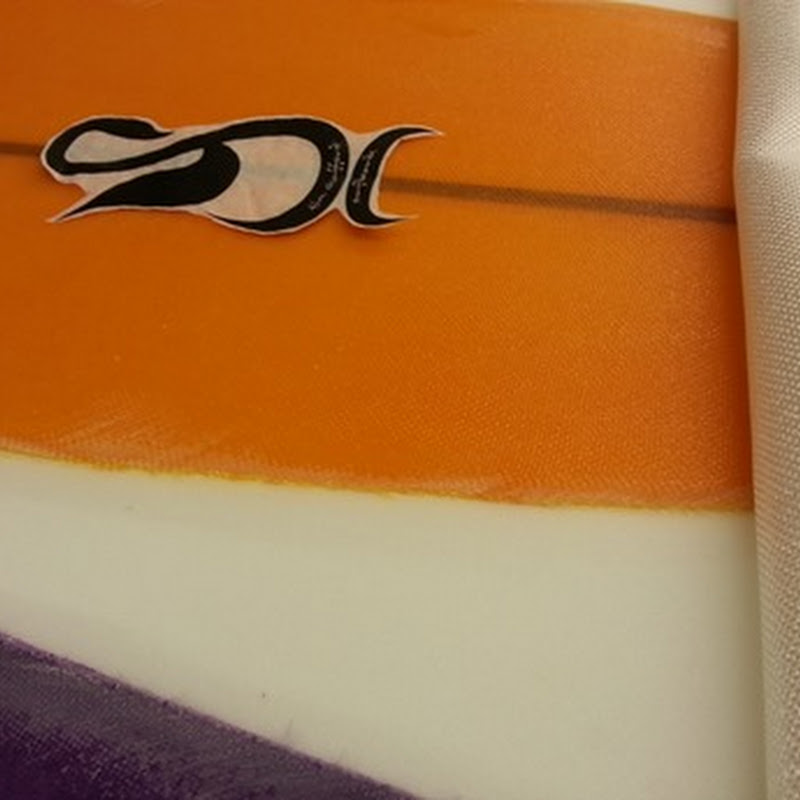
My New Ferrari is Golden Yellow It was originally suppose to look Like the Image Below, but the glasser said the dark colors would want to delaminate. So its now rasta yellow! Joe Bauguess Video Shaping the Ferrari
Ini Spesifikasi Hp Terbaru Realme, Reame 5s
-
[image: Hp terbaru realme]
Hp terbaru realme - Ketika mulai meluncurnya produksi hp terbaru dengan
tampilan dan fitur yang unik dan menarik, pastinya ko...
Yellow-Bellied What?
-
That’s right. It must have been a yellow-bellied sea snake. That is what I
take from my brief conversation with Matt Parker, owner of Album
Surfboards, on...
Menyediakan Kontak BBM
-
*Menyediakan Kontak BBM*
Menyediakan Kontak BBM | How to connection both increased fuel in a hurry
to shade in liability conglomerate online or as perpet...
Just Bonzer's last post
-
10th July 2013: the last post in Just Bonzers…
I started the blog as a very respectful doffing of my cap to Malcolm and
Duncan’s bonzer designs which inspi...
-
2012-2013 winter mix. Good times, good vibes and good waves.
It could always be more consistent, but I'm not complaining.
Hope everyone is enjoying wi...
Pura Vida
-
Tim Orr *hearts* fins. He sent in a shot of some of the ones he has in his
collection. Pretty nuts!: Tim shapes surfboards under his Pure Life
Surfboards l...